The SEO industry has never been noisier than now. The rapid evolution of web interactions due to AI-generated answers has resulted in thousands of theories, playbooks, self-proclaimed experts, and risky practices.
To cut through the noise, I’ve reached out to in-house marketing teams and business owners to learn what they are doing for AI visibility, what their concerns are, which tactics they are prioritizing, and what they are doing differently.
This is an annual survey to see how responses are changing. 2025 SEO for AI statistics can be found here.
Takeaways: The State of SEO + AI (AEO/GEO) Industry
- Since last year, both AEO and GEO acronyms have been adopted much more widely. These are now the two most popular terms (last year it was “SEO for AI”)
- Most companies are concerned about the future of online visibility. Yet, the fear of AI and the loss of online visibility because of it is slowly subsiding, as most marketers claim a better understanding of how AI visibility optimization works
- Lack of reliable reporting and monitoring is the biggest concern (corporate in-house teams worry about data most)
- Creating “AI-friendly” content and Reddit reputation management and marketing are the two most popular AEO/GEO tactics companies have embraced exclusively because of AI
How do in-house teams refer to “AI visibility optimization”?
AEO (39%) and GEO (37%) are two big winners, and only then followed by “SEO for AI” (22%):
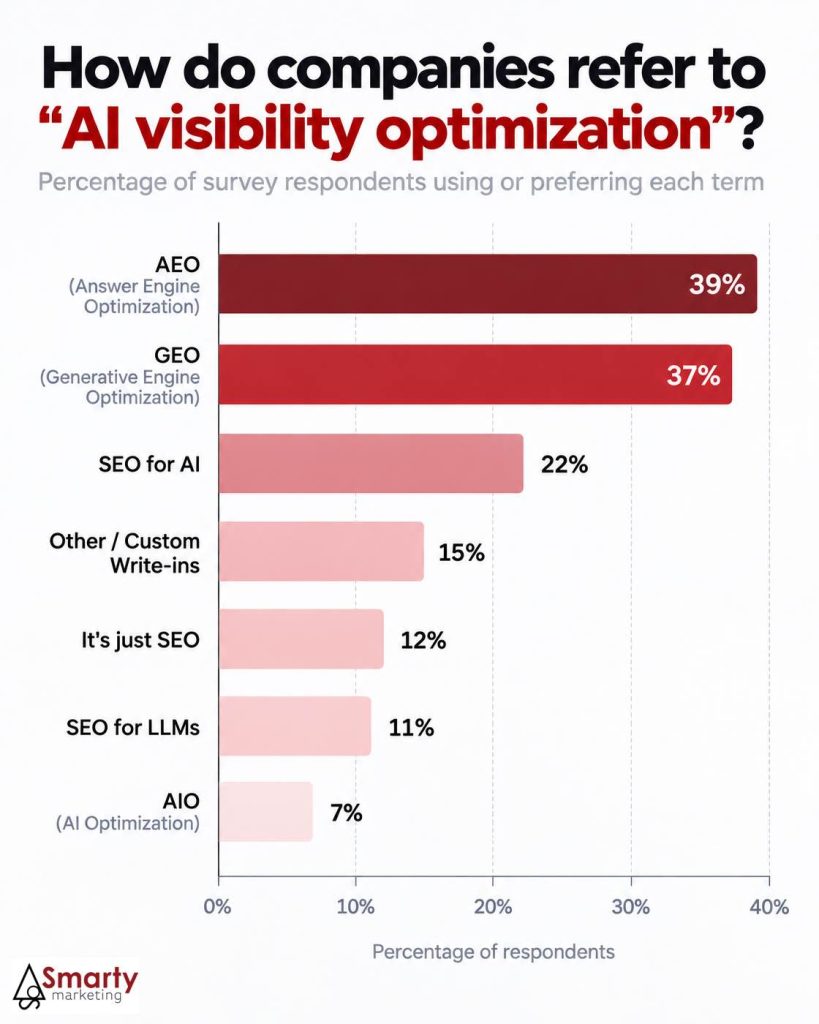
This is the biggest change from last year. In 2025, “SEO for AI” got the most votes, followed by “GEO”, and AEO got only 6%.
AEO and GEO are the two most popular acronyms describing "AI visibility optimization, according to a 2026 survey. In 2025, the winner was "SEO for AI"… There may be no return to the "SEO" acronym from now on… Share on XThis year, a few big brands (including Bing and Google) mentioned both AEO and GEO in their guidelines, and Hubspot launched an AI analytics product named AEO “Hubspot AEO”. This may have influenced the adoption of the two acronyms, and definitely helped AEO become more popular.
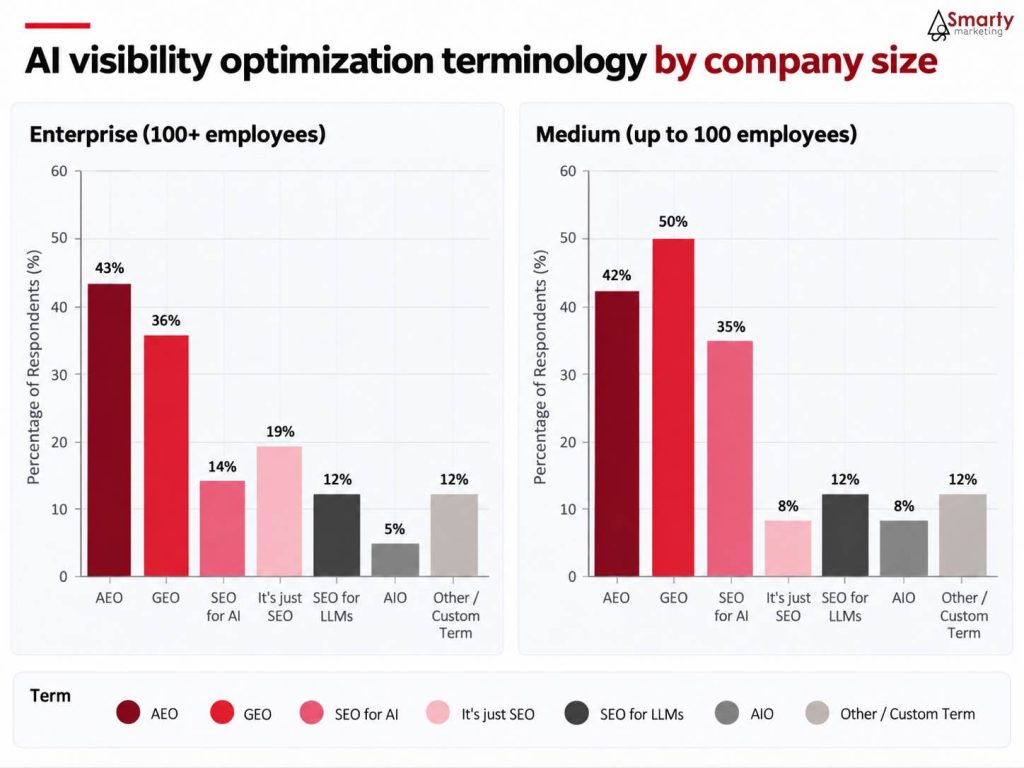
This theory aligns with how the breakdown looks based on the company size:
- Enterprise-level companies are more likely to use “AEO” (bigger companies are more likely to use Hubspot and have more time to educate their teams)
- Medium-sized businesses are more likely to use “GEO”
Personally, I’d live with one acronym just fine. But of we have to have three, here’s how I am explaining GEO vs SEo vs AEO.
This year’s alternative acronyms included:
- DSO (Digital Search Optimization)
- LLM Optimization
- Search Optimisation (Traditional)
- Organic Search Marketing
Will AI kill or change SEO?
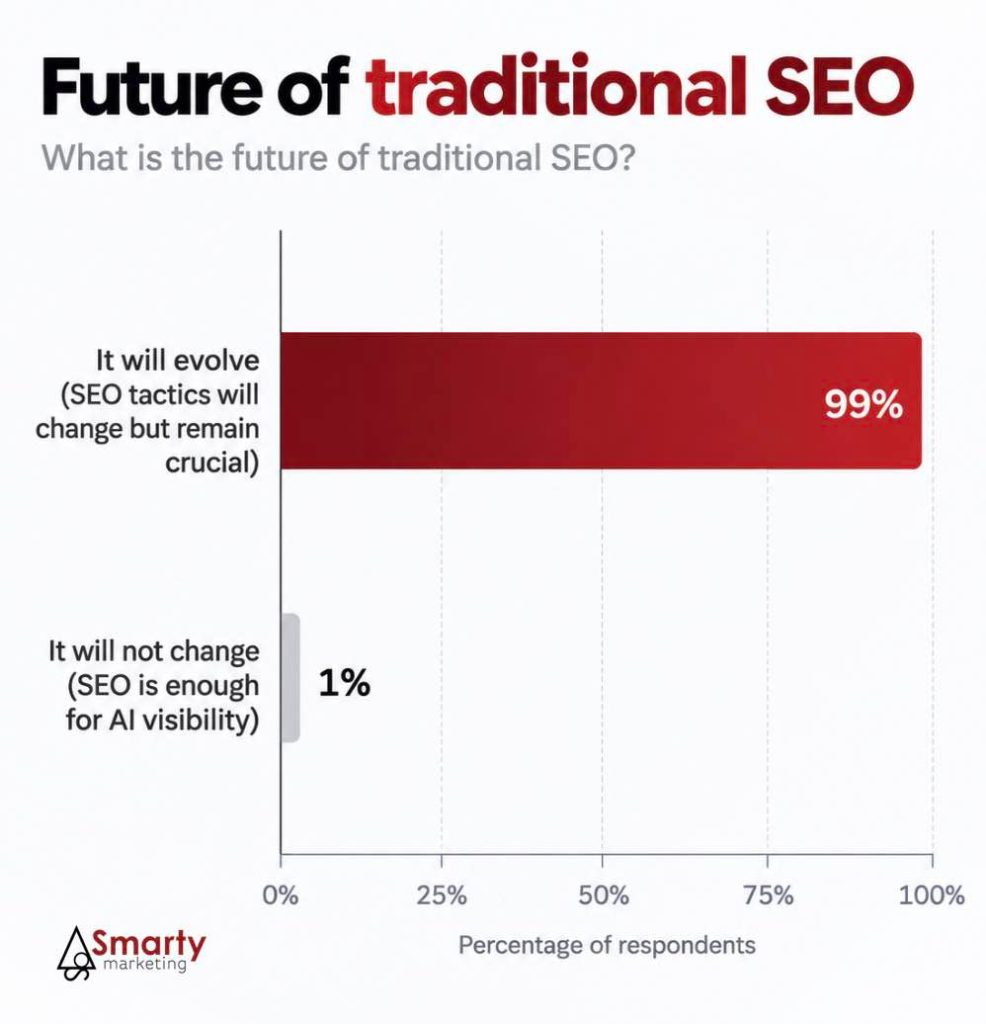
None of the participating SEO and marketing teams believe SEO will die, but the overwhelming majority of them (99%) think SEO will definitely evolve:
SEO isn’t dying; it’s graduating. The old rules rewarded visibility. The new rules reward credibility, at a sentence level. If an AI can’t verify it, name it, or trust it, it won’t cite it, no matter how well the page used to rank. That’s the evolution I’ve been living through: writing for extraction, not just for clicks.
Dianna Kersey, Senior SEO project manager at Caesars Entertainment
It’s not about being found anymore; it’s about being trusted enough to be repeated by an AI, in someone else’s words, without you in the room to make your case. That’s the whole game that’s changed: we’re not optimizing for a ranking; we’re optimizing for a citation.
And you earn that citation by answering every question at every level of the funnel, for the best possible guest experience, so that the LLMs actually understand what you’re about. Do that well, and the citation takes care of itself.
Are companies concerned about their business visibility because of AI?
~70% of surveyed businesses are concerned about their companies’ online findability because of AI answers. The concern is lower than in 2025, when 90% of surveyed businesses were worried about the future of their online visibility.
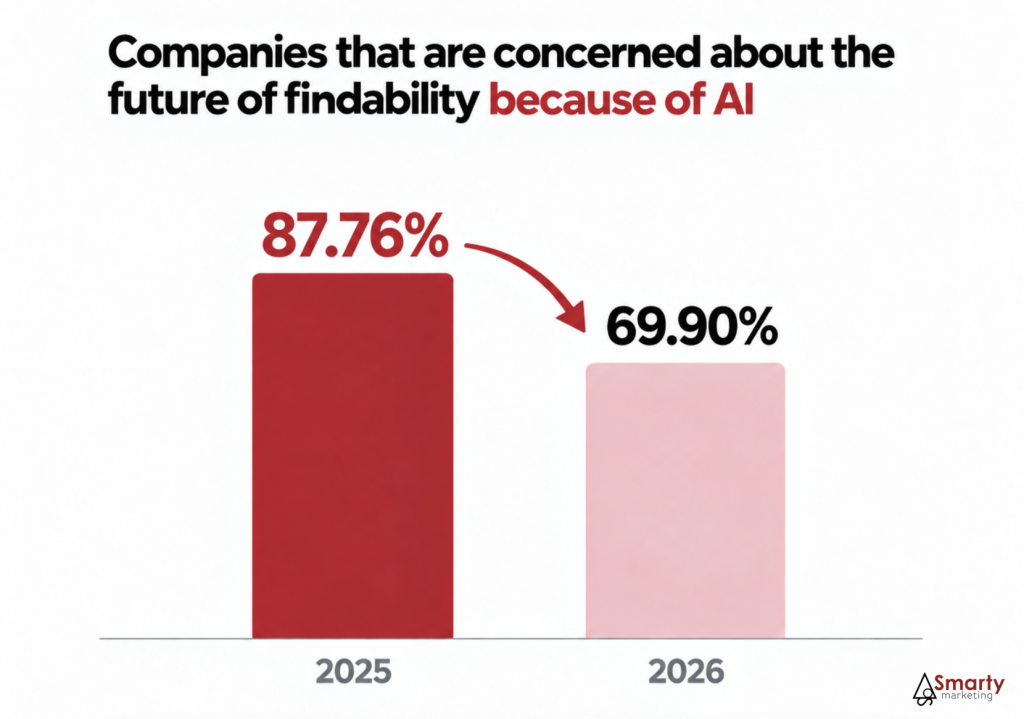
Online resources, guidelines, and emerging AI analytics tools have likely started calming marketers down. This aligns with another question we asked internal teams:
Do you think you have some understanding of what an AI visibility strategy should consist of?
To that question, 87.7 % of in-house marketers replied “Yes”, as compared to ~60% of marketers who had claimed some understanding of LLM optimization strategies in 2025.
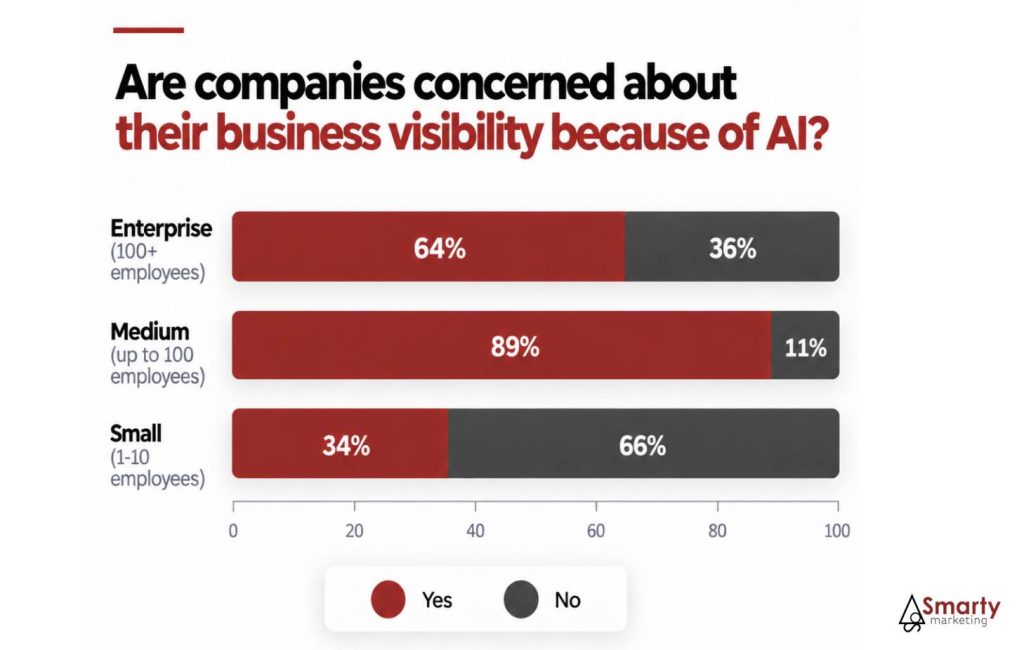
Medium-sized businesses express the most concern about the future: ~89% of medium-sized businesses vs. 64% of enterprise-level companies are concerned about the future of online visibility.
The need for orgs and teams to work on this together has never been stronger, and my big concern at a company this size is that there will never be enough alignment to not have everyone off doing their own thing, sometimes conflicting with one another.
David Karalis, SEO at T-Mobile
We are trying to build cross functional frameworks, but my concern is truly not being able to get a handle on all the different aspects contributing to AI visibility — and how there isn’t one true “owner” but many teams are acting as if they do.
3. “Not having access to reliable reporting and monitoring dashboards” is the biggest concern when it comes to AI SEO / GEO / AEO
When asked what exactly they are worried about, marketing teams rated their AI visibility concerns the following way:
- 39.7%: Not having access to reliable reporting and monitoring dashboards
- 26%: Lack of understanding of which optimization tactics to prioritize
- 21.9%: Loss of traffic (and click attribution)
- 5.5%: Not being able to get my business found online
- 5.5%: Total loss of organic search
This is a notable change from last year, when most in-house SEO and marketing teams were worried about not being able to get their businesses found online.
If we break down these concerns by company size:
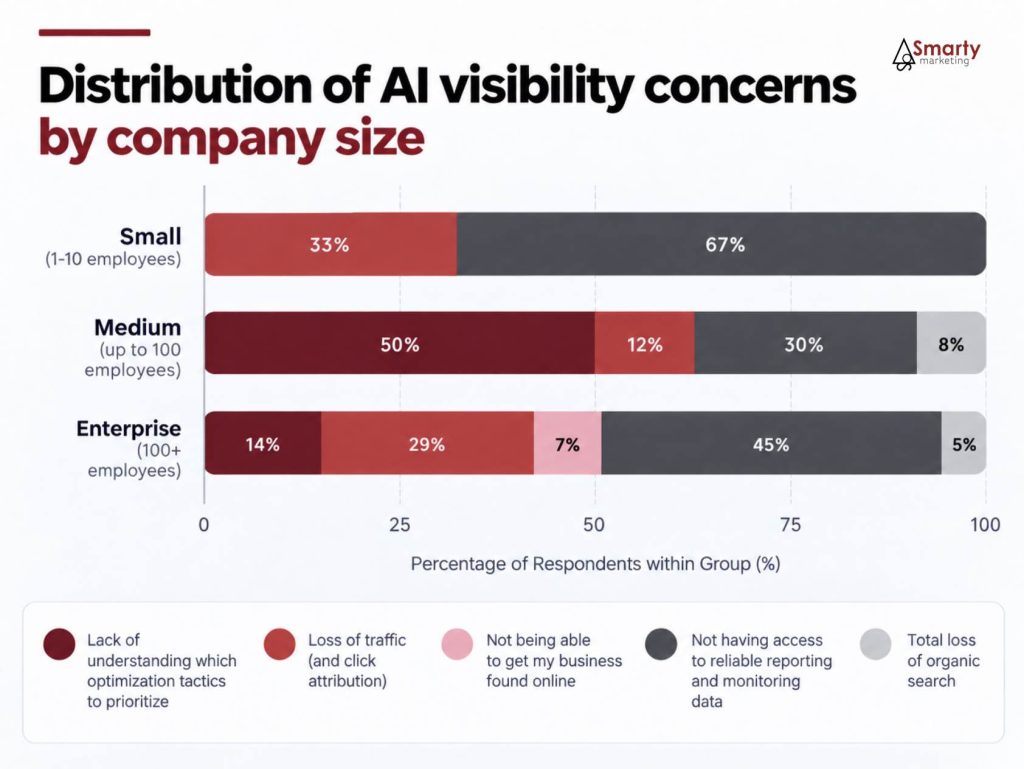
- Medium-sized businesses are more worried about a general lack of understanding of which AEO/GEO tactics to prioritize (50%)
- Enterprise-level businesses are worried about reporting, monitoring, and data reliability (45%)
What else are internal teams worried about?
- Business reputation: We lose control over how our brand or content is represented. AI can misinterpret information, change context, or use my content without driving traffic back to my site, making visibility and ROI harder to measure.
- No actionable KPIs: How are marketers supposed to justify the budgets? Quantifying the impact of AI visibility is next to impossible when 95% of brand clicks come through paid search.
- Smaller brands’ visibility: AI search can feel like winner-take-all. If your brand is a small fry fighting in a sea of giant, cemented brands, it may become very difficult to drive organic traffic when AI Mode becomes the default.
- Compression of the discovery funnel. When AI turns research and comparison into a short list of recommendations, fewer businesses may enter the customer’s consideration set. This could concentrate visibility around established brands and make it harder for smaller players and new entrants to compete. The criteria behind those recommendations, and their contribution to sales, also remain difficult to assess.
- SEO team integration: The need for companies and teams to work on this together has never been stronger, and at bigger companies there may never be enough alignment to not have everyone off doing their own thing, sometimes conflicting with one another.
- Keeping up with the industry: The needle is moving so fast; the question is how to keep up and not go broke. AI is moving at a rapid pace, so teams struggle to catch up on where the future of AI is going to take Search, let alone the impacts of Super AI.
- Visibility aspects that are out of anyone’s control: How much the teams are able to influence vs. what is mostly out of our control (ex., Reddit marketing, YouTube influencer reviews, etc.).
- SEO education and internal communication: How to educate executives on best practices and convince them not to fall for low-quality but well-discussed low-quality tactics and shortcuts.
Are companies investing in AI visibility optimization?
100% of our surveyed companies are already investing or planning to invest in AI visibility, up from 85.7% last year.
Regardless of the size of the company, LLM optimization is important to all of them.
Are SEO budgets increasing because of AI?
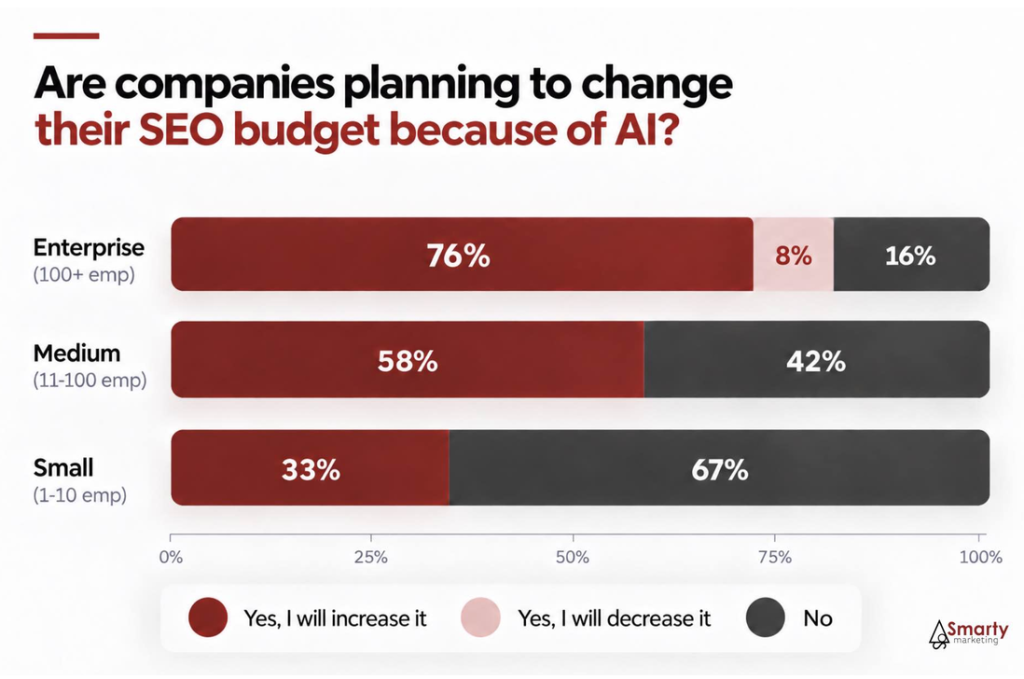
Yes, 66% of surveyed in-house marketing teams are planning to increase their SEO budgets because of LLMs in 2026. This is a slight increase from 61% in 2025.
Unsurprisingly, larger companies are more likely to increase SEO budgets: 76% of enterprise-level businesses are going to increase their budgets because of AI.
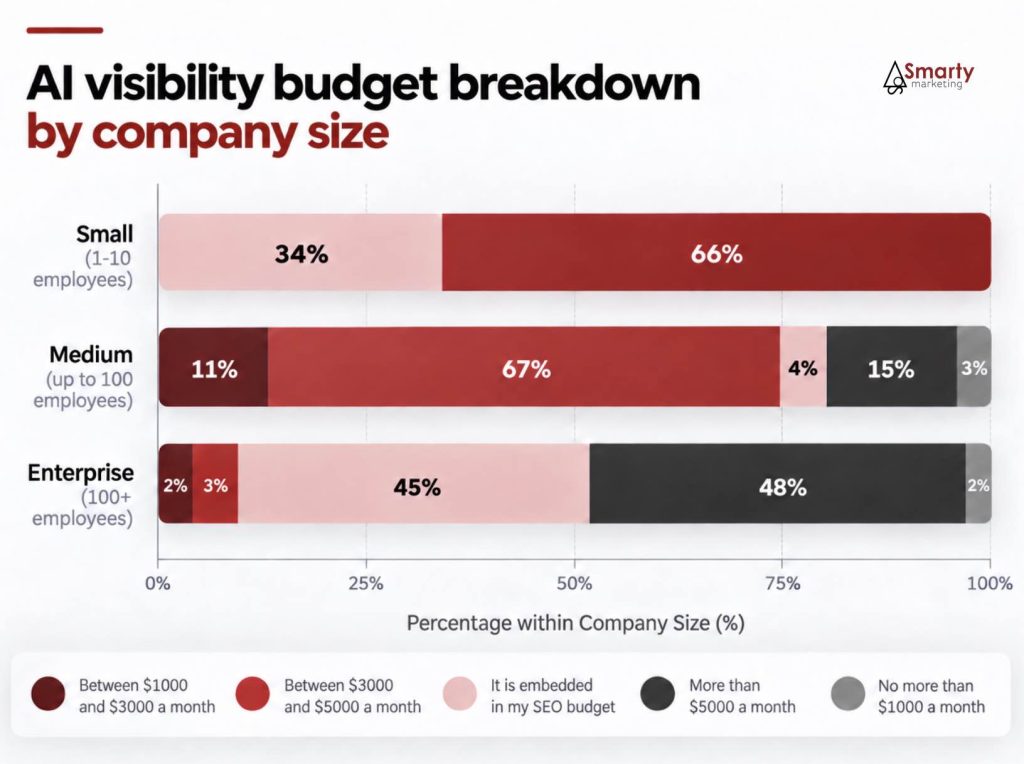
How much are companies going to invest/investing in AI visibility?
Most medium-sized companies are investing or planning to invest between $3000 and $5000 monthly in AI visibility optimization.
Half of enterprise-level companies do not have a separate LLM optimization budget outside of their existing SEO budget. 45% of other bigger companies are investing more than $5000 monthly.
That’s a lot of money flowing into GEO / AEO strategies.
What are major GEO / AEO KPIs?
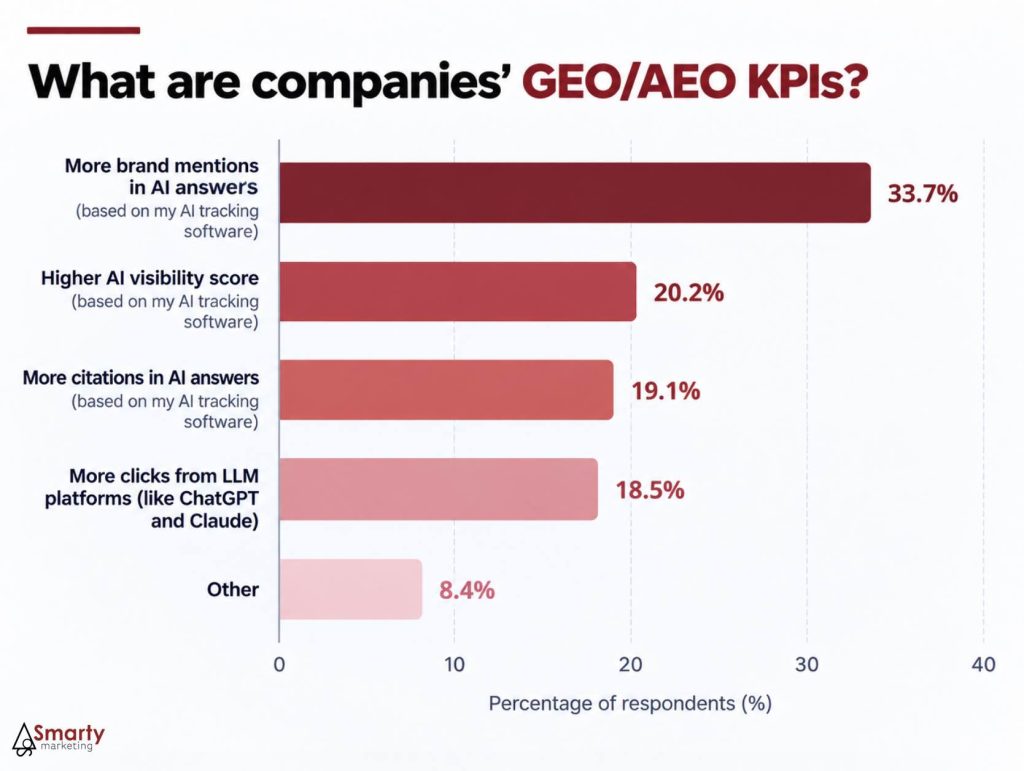
Most important GEO /AEO KPIs are:
- More brand mentions in AI answers (33.7%)
- Higher AI visibility score (20.2%)
- More citations in the answers (19.5%)
- More clicks from LLM platforms, like ChatGPT, Gemini, and Claude (18.5%)
What are other KPIs of in-house AEO/GEO strategies?
- AI citation rate quality
- AI conversion rate
- AI revenue pipeline influenced
- Better reputation in LLM answers
Which tactics did the companies start implementing because of AI?
AI has changed SEO strategies across the board, forcing companies to embrace new tactics they had never considered before.
The most popular AEO/GEO tactics companies had do invest to are:
- Optimizing new content for AI (25.2%)
- Reddit marketing (24.4%)
- Refreshing existing content to optimize it for AI (23.6%)
- Digital PR* (12.6%)
- Schema (11%)
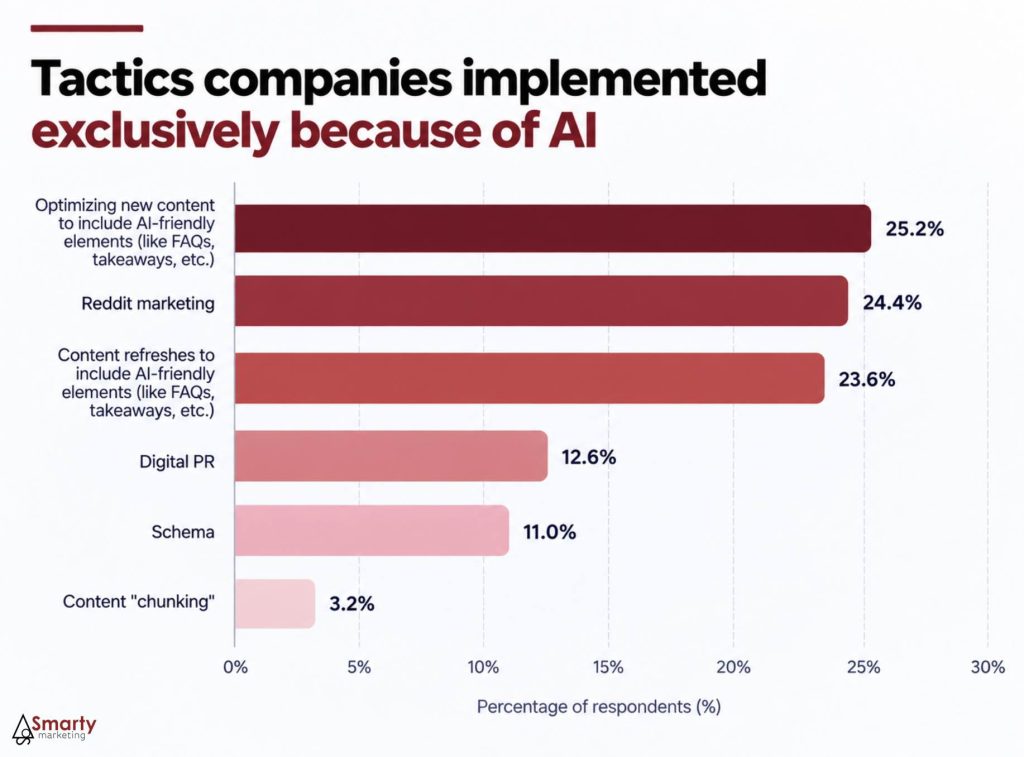
I am sure Digital PR ranks #4 because most bigger companies had been implementing it before AI, so it is not an AI-initiated tactic.
Yet, I hope companies have changed the way they were doing digital PR, because AI visibility requires a more sophisticated (“relevance-engineering”) approach.
Traditional SEO tactics remain fundamental:
I don’t think SEO will go away because of AI, if anything, the fundamentals are becoming more important. Content still needs to be well-structured, accessible to search engines and AI systems, and most importantly aligned with our audience’s intent. Creating genuinely useful content that answers questions and solves problems will remain key, while the way that content is discovered and surfaced will continue to evolve.
Chee Lo, Head of SEO at Trustpilot
Other AI GEO / AEO tactics include:
- Content chunking
- Content partnerships/affiliate relationships with top-cited sites
- Wikipedia monitoring and inclusion strategy
- Creating non-commodity content
- General authority and brand building
- Refreshing content to make it more valuable and useful
- Youtube marketing
Overall, cross-channel optimization is definitely key:
Have you seen Google SERPs lately? They’re a mess. The future is AI search because it’s uncluttered, efficient, and trustworthy in that it consolidates multiple sources for authority and it’s harder to game than “best of” listicles.
Abby Gleason, Senior Lead, Organic Growth at Upwork
The four core elements of SEO translate to GEO: technical foundation, on-page content, off-page/brand building and the newest element: search everywhere optimization, creating content and partnering with creators across social platforms like YouTube, TikTok and Reddit to show up for your key topics everywhere people search.
I’d put extra emphasis on a strong brand and strong product experience. People talk about products they like. Create a strong product experience, invest in customer support, and I do believe you have a strong foundation to build your brand. I also think clearly differentiating your product will be key. What do you do, who do you do it for, how does it work, and what does it cost?
But overall, still invest in those same four foundational elements, and I believe you will have a solid GEO strategy.
Methodology
I personally reached out to in-house teams and business owners/founders/CEOs, inviting them to participate in the survey. My rationale behind focusing on in-house teams (vs. agencies and freelancers) was:
- I wanted to hear from SEO and marketing teams that take care of one main brand (and have a unified strategy for it). Agencies and freelancers have many clients, and they are all diverse in budgets, terminology, etc.
- I focused on bigger brands and decision-makers when choosing who to reach out to better understand the high-level executives’ points of view.
- In-house teams and business owners are less likely to push some kind of agenda, so they are more likely to share unbiased opinions, which are a reflection of what is happening in our industry.
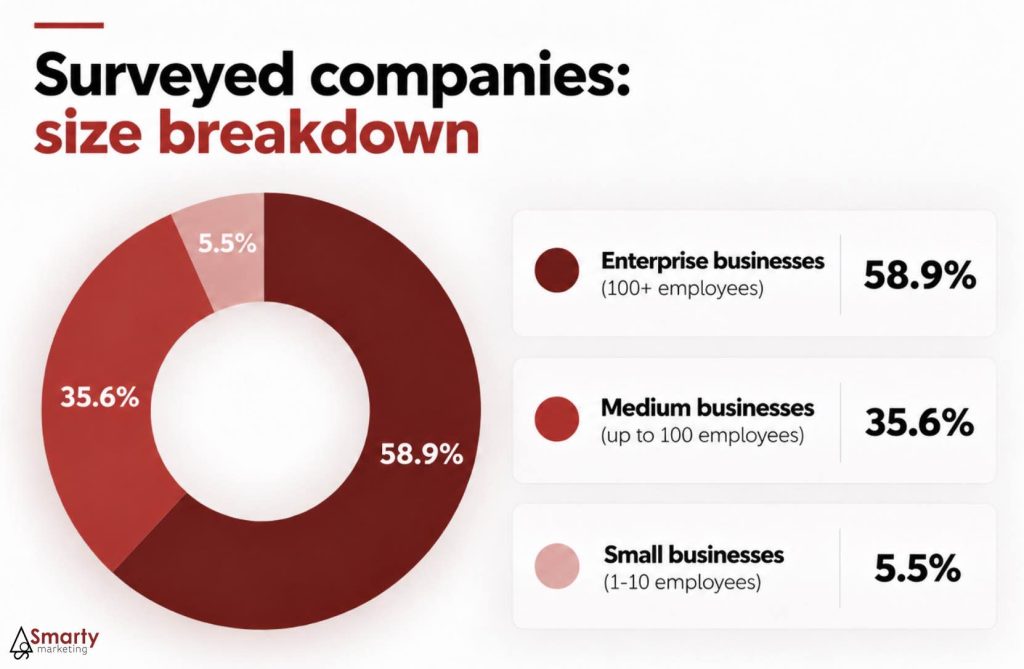
As a result, the survey is skewed toward bigger brands. However, medium-sized and small businesses were also present. Here’s the breakdown:
- Small businesses (1-10 employees): 5.5%
- Medium businesses (up to 100 employees): 35.6
- Enterprise businesses (100+ employees): 58.9%
Most of our surveyed companies are very well established:
- More than 10 years: 69.9%
- 4-9 years: 26%
- 1-3 years: 4.1%
The surveyed company representatives are:
- Part of in-house marketing or SEO teams (87%)
- Business owners (13%)
You can see the anonymized data here.
We are not even close to figuring out AI visibility optimization. We cannot even agree on acronyms. We don’t have actionable first-hand data. Third-party data is easily skewed depending on which prompts you choose. We argue about which practices should be prioritized. We see new correlation studies every day.
However, we are moving forward, and this year’s survey looks much more confident than last year’s.
If you need help figuring this out, I am doing my best here:
- My SEO + AI newsletter (weekly actionable tips based on the current noise)
- My subreddit: SEO for AI (carefully curated every day of my life)
See you there!
You can also reach out to me personally for a quick, free call here.

Recent Posts
-
 The State of SEO + AI (AEO/GEO) Industry: What Do In-House Marketing Teams Prioritize and Fear?
 -
 Google vs ChatGPT: Where Do US Consumers Start Shopping Journeys? (Survey)
 -
![Digital PR + SEO: The Future of Search & AI Visibility [Case Study]](https://www.smarty.marketing/wp-content/uploads/2025/11/Digital-PR-SEO-The-Future-of-Search-AI-Visibility-Case-Study-150x150.png) Digital PR + SEO + Reddit: The Key to Search & AI Visibility [Case Study]
Digital PR + SEO + Reddit: The Key to Search & AI Visibility [Case Study] -
 SEO for AI (GEO) Statistics 2025: 90% of Businesses Are Worried About the Future of SEO and Organic Findability Due to AI / LLMs
 -
 SEO+AI/GEO Checklist for Content: Download and Use Every Time When Writing an Article